Low touch
Technology and integration for teams that run the work themselves.

The product family
Sonar finds activity worth investigating. Investigator puts the evidence into a case workflow. Collaborator adds governed information sharing.
01 / Sonar
Detection and transaction monitoring
Help investigators spend their time on relevant findings.
Sonar looks at transaction patterns and relationships in the bank's own data. It combines learning across institutions with local analysis, while the bank retains its raw records and customer identities.
What this means for your team
98–99%of alerts relevant in a focused queue, across five simulated banks
In a focused setting, almost every alert was relevant, and the queue caught roughly a quarter to a third of the suspicious activity. In a broad setting, the team handles five times as many alerts, about half of them relevant, and catches roughly three quarters. Sonar lets you choose the balance that fits your capacity and risk appetite.
All results come from our synthetic development environment, five simulated banks on one setup with a dense transaction network between them. Real-bank performance is what we test next with partner banks. The experiment and its conditions →
| Focused queue | Broad coverage | |
|---|---|---|
| Alerts per 1 million transactions | 1,000 | 5,000 |
| Share of alerts that were suspicious | about 98–99% | about 43–64% |
| Share of all suspicious activity caught | about a quarter to a third | about three quarters |
Synthetic data · The development corpus
Training and testing at scale against known patterns before the work with partner banks begins.
02 / Investigator · Includes Sonar
Investigation and reporting
Bring the evidence, the questions and the next decision into one investigation workflow.
Explore the transaction graph, query the evidence, bring in KYC context and prepare evidence-linked narratives and goAML reporting material.
The investigator and MLRO retain decisions and reporting authority. Integration follows the bank's systems and agreed operating model.
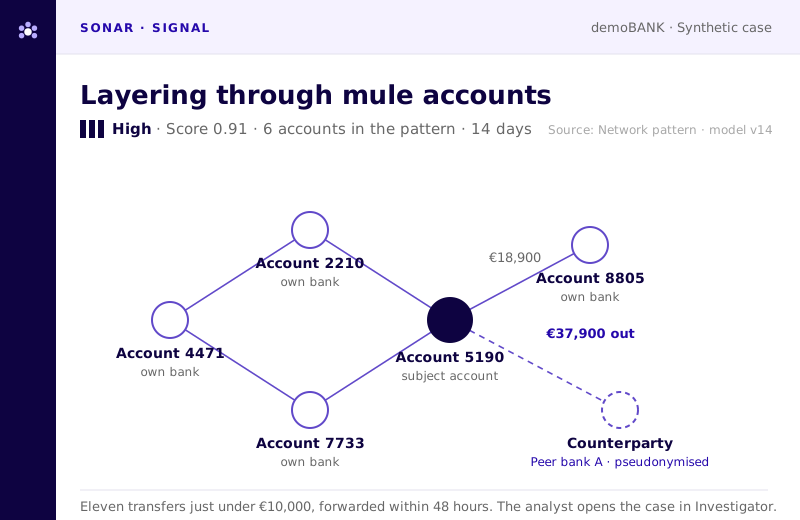
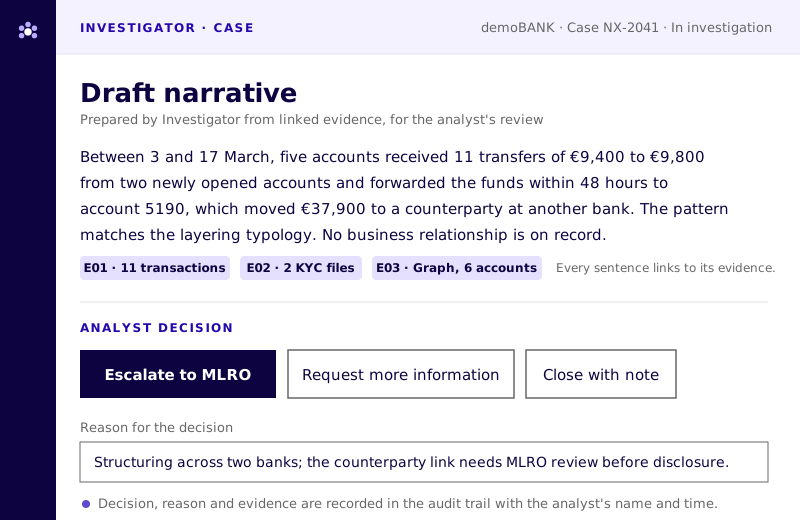
Synthetic case, drawn from the product workflow. The case data is invented.
03 / Target July 2027
Collaborator
Build shared case context when there is a reason and authority to share.
Collaborator develops the next step in information sharing under AMLR Article 75. It starts with limited signals and adds detail as risk, purpose and disclosure authority justify it.
Targeted for July 2027, alongside the regulatory and partnership arrangements.
Follow the regulatory path →How we work with a bank
Technology and integration for teams that run the work themselves.
Product access with support for setup, configuration and the operating workflow.
An operated-service option, with responsibilities agreed for the engagement.
The scope and responsibilities of these models are being developed with banks and regulators.
See the workflow for your bank.
Request a briefing →